Chattanooga, Tennessee
Council Fire
Council Fire opened in 1992, built to bring a professional tournament to Chattanooga, and spent 33 years owned by one of its founders. In December 2025 the members purchased the club at a discount and are steering it toward a future of continued excellence in partnership with its namesake community.
LOCATION
Chattanooga, Tennessee
OPENED
March 1992
ARCHITECT
Bob Cupp
ACCESS
Private
OWNERSHIP
Member-owned
GREEN FEE
Members only
Becky Eaves lived her whole life at the corner of Julian and Davidson Roads, in the farm country east of Chattanooga, and at some point she sat down and wrote a history of the place. She gave a copy to the developers who had bought the land across the road. One of them, Jon Kinsey, passed it to his partner Jack Lupton, and a few days later Lupton telephoned. "Have you got a pen and paper?" he asked. "Write this down. Council Fire Ridge. That's the name of the golf course."
What Lupton had taken from the book, by Kinsey's account, was that the ground had been sacred to the Cherokee who lived there, and that they held their council meetings around a fire. Kinsey liked all of it except Ridge, and convinced Lupton to forgo "Ridge" in the name. Council Fire opened in March 1992 and signed itself, from the first day, with a drawing of a feather.
Thirty-four years later the mark got an update, right as Kinsey's name came off the deed. By December 2025 he had agreed to sell Council Fire to its own members, at a discount, though the price was never disclosed. As it turns out, Kinsey had spent most of that year trying to sell it to an entirely different party.
The year the deal fell through
Kinsey is 71. He was mayor of Chattanooga from 1997 to 2001, and eventually helped bring the Choo Choo back from the dead. For 33 years he was also the managing general partner of a golf course he had never meant to build. He decided it was time to sell and he did what an owner in his position does, which is take meetings: first with the golf course management companies, then with the private equity firms standing behind several of them.
By the autumn of 2025 he had a deal. Then the buyer got cold feet, and Kinsey woke up one morning with a golf course he had already decided to part with and no buyer.
There was one call he had not made. Frank Proctor was a longtime member who lived in the community the club shares a name with. Months earlier, hearing a rumor that the club was already sold, he had told Kinsey he wished the membership had been given a chance to bid. "Jon and I had been friends for a long time," Proctor said afterward. "I just didn't like the idea of somebody coming in buying our golf course." Kinsey rang him back and asked whether he was still interested. Proctor said he would see what he could do and started making calls.
What Proctor was bidding against
If the members had not bought Council Fire, somebody else would have, and the list of who that would be is short. American private golf is consolidating around a few companies that own clubs by the dozen, the way a real estate trust owns strip malls. They buy those clubs from the people who built them.
Invited, formerly ClubCorp, is the largest of these companies, with more than 200 clubs. Arcis Golf has around 70. Concert Golf Partners has 39, and Concert Golf is the one built for this exact moment in a club's life: the aging owner, the deferred capital, and the members who won't take an increase in capital dues. It pays cash to buy out the existing ownership of the club, clears the debt and funds the capital work. That is Concert Golf's entire thesis, whether a club is owned by a small group of individuals or by its membership.
Money moved through golf twice in the same week Kinsey was taking his meetings. Bain Capital closed its purchase of Concert Golf from Clearlake Capital on November 17, 2025, in a deal valued at more than $1.3B. The next day, Topgolf Callaway Brands agreed to sell 60% of Topgolf to Leonard Green & Partners, valuing that business at about $1.1B. Then, five months later KSL Capital Partners agreed to buy Invited back from Apollo for up to $3B, which KSL was well placed to price, having owned the company once already.
A club that needs money is usually glad to see one of these parties show up. They are competent operators who turn up with capital at the one moment a golf course cannot raise any of its own. We'll be frank, they also turn up with a hold period and a target return, and everything that happens to the golf course afterward runs downstream of those two numbers.
Kinsey sold to the members instead. "I'm selling it to them at a discount is going to cause me a little bit of grief with some of my investors," he told the Chattanoogan in December. A seller who takes a discount cares who owns the place next, and Kinsey chose the people who already played there.
The origin story
Council Fire exists because a golf tournament wanted a better date to bring the best golfers in the world to town.
The Chattanooga-Hamilton County Classic had never held a week of its own. It played opposite the U.S. Open, then opposite the World Series of Golf, then opposite the British Open, which is three different ways of asking golfers to come to Chattanooga while the best players alive are on television somewhere else. In June 1990 Buddy Henry, who ran the Classic, flew to Medinah with Jack Lupton, chairman of The Honors Course, to put the case to commissioner Deane Beman in person. They brought a bargaining chip: the promise of a new golf course.
They did not have one. What they had was Kinsey's land.
Leonard-Kinsey and Associates had bought 303 acres in East Brainerd for apartments, on ground that runs over the state line into Georgia. Lupton covered close to half the equity and about 10 other investors covered the rest. Lupton's ties to Augusta National are how Bob Cupp got the commission, and Cupp's first finding was that 303 acres was not enough. So the partners went to the neighbors and bought two adjoining farms, roughly 150 acres between them. One of the two belonged to a Mrs. Million. "We didn't pay her a million, but we paid her a lot," Kinsey said.
Not everybody in Chattanooga welcomed the project. Members of the Cherokee Nation challenged the development and accused the partners, as the Chattanooga Times reported it, of trying to "desecrate a valuable archeological find." Leonard-Kinsey had owned the ground for years and had commissioned archeologists long before. "It goes without saying that this whole area is full of Indian history," the company's vice president Ken Hays told the paper in the summer of 1990. "But there is no evidence that there are massive graves here. Our lawyers have gone over it, and we've got clear title on the property." The club publishes all of that itself, on its history page.
From the start, Council Fire was never only a golf course. Cupp drew house lots into the original routing and the partners sold memberships alongside them: $1,000 to reserve a lot, a membership with no initiation fee, with dues beginning the day the course opened. Eighty-three lots went in two weekends in August 1990. The course opened in March 1992 and hosted the Classic that July, which is what it had been built to do.
The part where they have to run it
Here is the thing about buying a golf course from the man who has run it for 33 years. You then have to run it.
The new board is nine people, with Proctor as president. It moved immediately to retain the general manager, the head professional, and Gary Weller, who has been superintendent for 24 years and before that ran Chattanooga's two city courses. Asked why, Proctor gave the best answer anybody gives in this entire story. "We don't know anything about running the golf course."
That is more reassuring than it sounds. The way member-owned clubs die is not apathy. It is nine enthusiastic amateurs discovering, one meeting at a time, that they have unsubstantiated opinions about agronomy.
What they have taken on is real. Kinsey put another $6M into the place over his last couple of years, and that was one man absorbing renovation and necessary upkeep costs. A member-owned club has no sponsor of last resort. JJKeegan+ puts the industry benchmark for a golf course at roughly 15% EBITDA, against renovation work that runs into eight figures. Club Benchmarking says a private club needs net available capital of 12 to 15% of operating revenue, every year, in perpetuity. Golf operations are structurally close to break-even. The irrigation that went in with the course is 34 years old, and one day it will be an agenda item - if it isn't already.
The capital project they inherited was finished in May, when the club unveiled a rebuilt 18th, 590 yards and a dogleg right, drawn by Mike Riley, who worked for Bob Cupp's firm before opening his own. What it cost has not been disclosed either.
How many existing members converted to equity has not been reported. The arrangement, as the press described it in December 2025, was conditional: if some present members opt out of becoming equity owners, there will be opportunities for others to join. Five months later the same paper described a surge of new members.
The feather
For 34 years the club signed itself in green calligraphic script. "CouncilFire", one word, capital C and capital F shoved together, above a speckled gold-and-olive feather. It was the house style of American golf in 1992.
It also did not match the name. The club is named for a fire that people sat around. The logo was a feather, which is a different thing, and the feather was drawn as a painted object, mottled gold and olive. That reads on a screen. It is a much harder thing to put on a hat.
By tracking the club's own website and social accounts, we noticed that in February, once the members officially took over, the old branding was retired.
The new branding comes from the namesake residential association that already signed itself with the same feather in a deep bottle green. The club took a version of the community's existing branding, turned it rust in a sport where everybody usually goes green, and added the golf club's founding year, 1992.
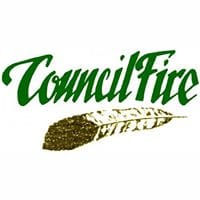
In use for 34 years. Designer unidentified.
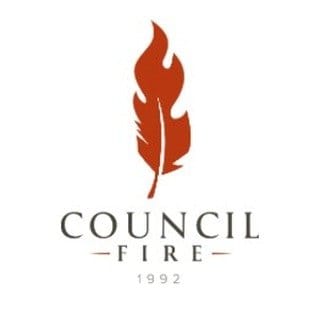
The feather is also a fire. Wordmark in charcoal, feather and date in rust.
The new mark is one shape, drawn to work in a single color, a burnt rust somewhere between ember and clay. It is a feather. It is also, if you look at it for two seconds, a fire: the barbs at the top curl and part into flames, then settle back into a feather with a clean central shaft. After three decades the club's logo finally contains its own name.
It also carries a date the old one never did. Beneath the feather, COUNCIL FIRE is set in letterspaced serif capitals, and under that sits 1992.
The obvious fix was to draw the fire itself. Putting the fire inside the feather is the harder answer, and it embroiders, and it survives at 24 pixels, and it can be cut into a gate.
Why the club dropped the word Golf
The club also dropped "Golf Club" from its name. It is Council Fire Club now, and the Instagram account has moved to match.
Read that against an open door for new members and it stops being a branding exercise. A membership that has just bought its own golf course and is recruiting cannot fill it from golfers alone. It fills it from families, from social members, from the person who wants a pool and a dining room and has no intention of ever holding a putter. Taking the word Golf out of the name is the cheapest possible way to say so. The website now leads with community and lifestyle and lists two membership types: Equity Golf, and Social.
So the new board's first decision was to make room for members who will never play. On the evidence, it was the right one.
The rollout is still catching up. The old mark is still on LinkedIn. The website's page titles say Golf Club while the copy underneath says Club. The Tennessee Golf Association lists a different domain entirely. A logo this abstract runs on repetition, and a feather with nothing beside it is just a feather.
A club with a storied history and a name drawing inspiration from the Cherokee leaders that met around a fire has sold after 33 years of ownership under one of its founders. It now answers to nine of its members, who meet as a board and will help guide it the next 33 years.
Sources
Chattanoogan.com, Chattanooga Times, Chattanooga Times Free Press, Council Fire Club, KPH Development, Golf Digest, Golf Inc., Bloomberg, Bain Capital, Leonard Green & Partners, Top100GolfCourses, National Golf Foundation, Concert Golf Partners, Club Benchmarking, JJKeegan+